


AI & connected operations
Turn information into a clearer decision.
Bring fragmented data into a useful foundation. Engineer pipelines, connect warehouses and build decision interfaces that make operational context easier to understand.
SEE HOW THE TECHNOLOGY WORKS
Your knowledge. A useful answer.
Follow a question from trusted sources to an answer your team can inspect.
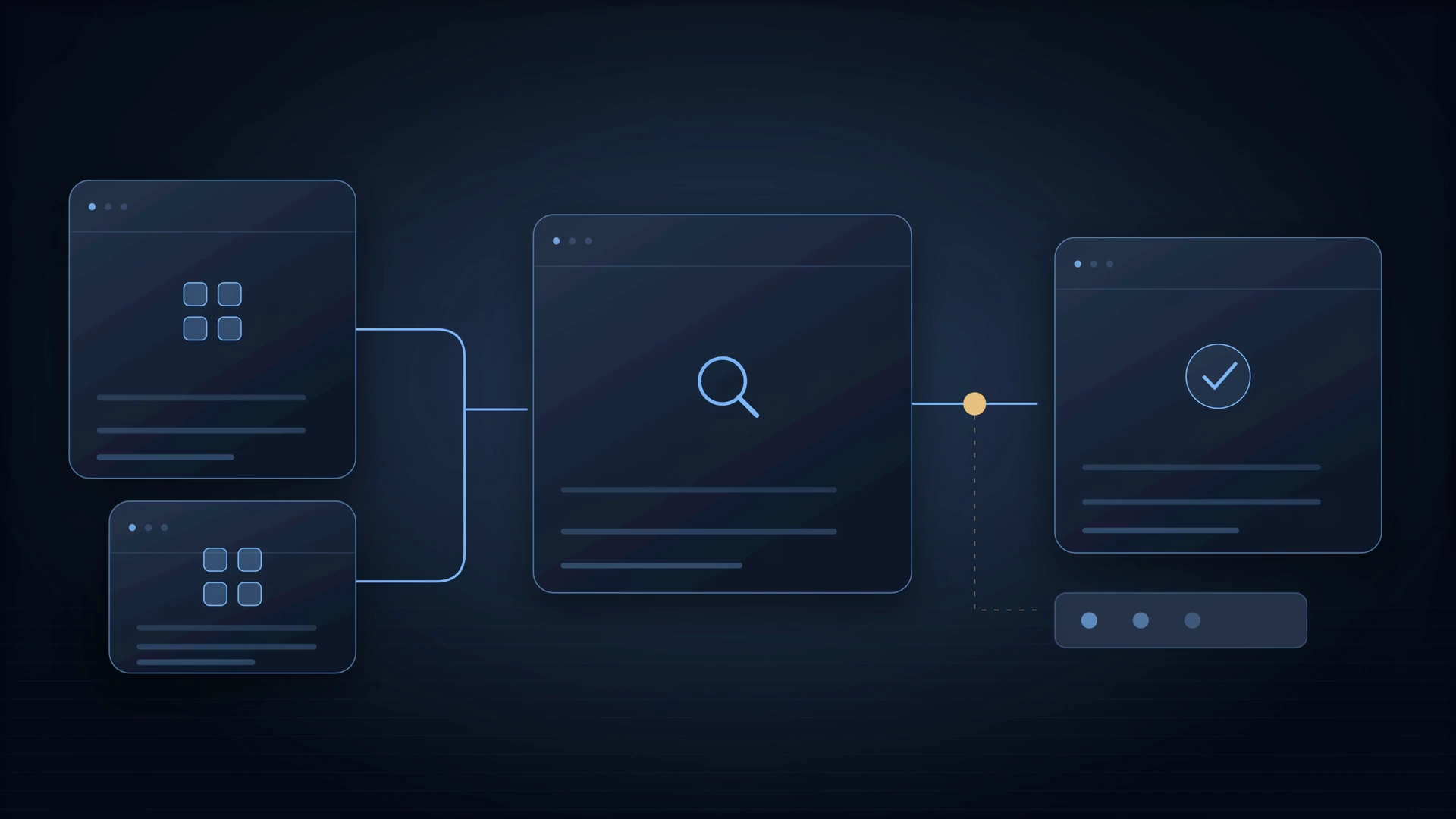
INTERACTIVE WORKFLOWIllustrative engineering scenario
01 / 03
Connect the sources
Select the documents, records and permissions the assistant can use. Freshness and access are part of the design.
Approved documents + access rulesA permission-aware knowledge collection
Read the complete workflow
Connect the sources
Select the documents, records and permissions the assistant can use. Freshness and access are part of the design.
Approved documents + access rules → A permission-aware knowledge collection
Retrieve the evidence
Find relevant passages for the question. Keep the source attached so the answer can be checked.
A customer or employee question → Relevant passages with source references
Answer with context
Present a grounded response, show the sources and hand off when the available evidence is not enough.
Retrieved evidence + conversation context → A reviewable answer and a clear next step
Consistent metrics across sites or departments
Explainable summaries linked to source data
FROM INPUT TO USEFUL OUTPUT
Follow the work. Inspect the result.
Explore a proposed delivery workflow. Each step connects an activity to something your team can review.
WORKFLOW BLUEPRINTIllustrative delivery design
INPUTS TO DEFINE
Source schemas, access and update frequency
Metric definitions and decision owners
Reporting, retention and governance requirements
REVIEWABLE OUTPUT
A traceable, quality-checked data flow
Map sources, identifiers and refresh requirements. Ingest and validate records, retaining lineage and surfacing missing or inconsistent data.
Reviewed against agreed requirementsWHAT WE DEFINE AND DELIVER
Practical artifacts. A shared definition of done.
The exact scope follows discovery. These are the building blocks we discuss, specify and review together.
- Data ingestion, transformation and quality
- Warehouse connections and semantic metrics
- Dashboards, reporting and embedded analytics
- Operational alerts and natural-language analysis
HOW THE PIECES CONNECT
Architecture with your operation in mind.
Source systems → ingestion and quality checks → warehouse or serving layer → semantic metrics → reports and controlled AI analysis. Data lineage supports investigation when a number changes.
Designed around real constraints.
- A dashboard does not repair an unreliable source; data-quality work is scoped explicitly.
- Forecasting and optimisation require suitable historical data and a separately evaluated model.
FIND THE RIGHT STARTING POINT
A product where it fits. A custom build where it matters.
Create a trusted data foundation before adding dashboards, natural-language questions or predictive models.
Bring your objective and the people it should help. We will shape a first scope and the evidence needed to move forward.
Discuss this projectYour starting point is carried into an editable inquiry. Nothing is booked or provisioned by making this selection.A CLEAR PATH THROUGH DELIVERY
One plan. Visible progress.
A complete build, a focused integration or specialists alongside your team. The engagement follows the scope—not a fixed team template.
- 01
Discover
Define users, the process, constraints and a useful first measure of success.
- 02
Design
Make the interface, architecture, data and integration decisions visible.
- 03
Build & evaluate
Deliver working increments and test the task, permissions and difficult cases.
- 04
Release & evolve
Agree rollout, recovery, handover and the people responsible for ongoing operation.
BEFORE YOU START
Good questions. Clear answers.
Can we keep our existing reporting tools?
Yes, where their interfaces support the required workflow. We can focus on pipelines, definitions and data delivery rather than replace every dashboard.
Where does AI add value?
Potential uses include summaries, assisted investigation and natural-language access to agreed metrics. Outputs must retain source context and be evaluated for the task.
LET’S MAKE THE NEXT STEP USEFUL
Tell us what needs to work better.
Talk with our team
Explore with our AI guide, or reach the people who can scope the work.