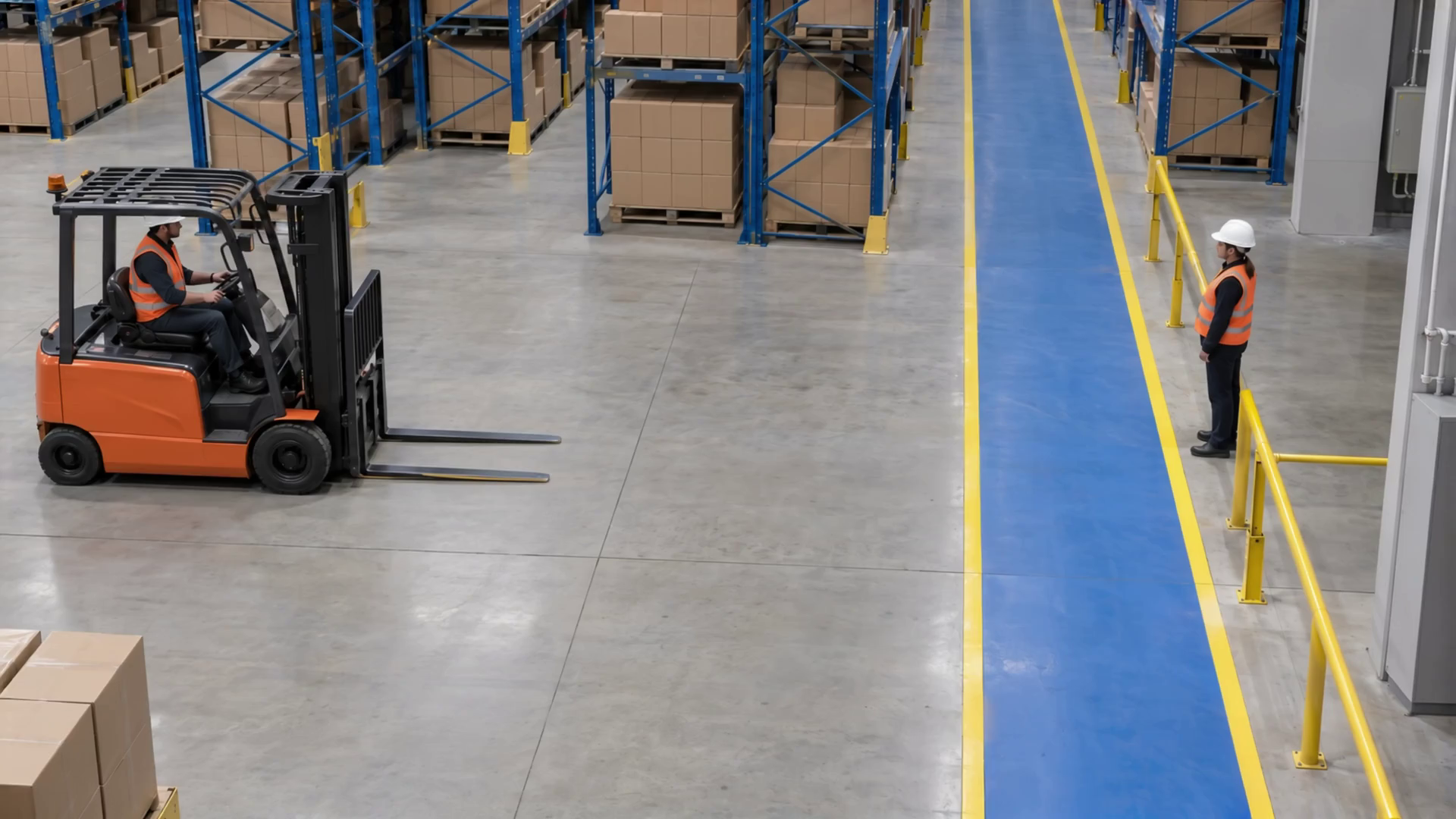
Vehicle, driver and pedestrian
One forklift, its visible driver and one separate pedestrian are present in the review frame.
Warehouses and factories bring people, vehicles, stock and machinery into shared spaces. Opsyte turns selected camera observations into events and metrics that warehouse, HSE and plant teams can use together. Start with a high-value route or bay, then build a wider operational picture.
Preparing for launch · tailored walkthroughs available VISION → CONTEXT → ACTION
The box includes visible forks. It is a screen-space approximation, not a calibrated vehicle footprint.
One forklift, its visible driver and one separate pedestrian are present in the review frame.
One forklift in each of the 13 frames manually reviewed at half-second intervals.
Positions and counts were manually reviewed every 0.5 seconds from 0 to 6 seconds. Interpolated boxes are approximate visual annotations, not live model inference. Event markers identify a confirming sampled frame, not an exact crossing instant.
Watch a defined vehicle approach zone before the walkway.
Focus a camera on a clear operational question.
Review the event, its source and the supporting evidence.
Help the right team review and respond to what matters.
Turn a view into useful data. Explore model families for people, service, safety, movement and production. Configure the measurements around your operation—and connect them to the questions that matter.
See when people arrive and how demand changes through the day.
A configured counting view supplies passage counts. The example compares two separate entrance views.
Illustrative data · change the location or period to recalculate every metric and report.
Passage counts in each observation window.
Interval total. Adds interval values for the selected sites and period.
Higher bars show busier arrival periods; the total adds the selected windows and separate sites.
A passage count is not a count of unique customers or verified identities. Overlapping views need duplicate handling.Arrival boundary
Arrival boundary
The illustrative records use equal 15-minute periods. These are example records, not customer measurements.
Example09:00–09:15 · illustrativeEvery measure belongs to a selected camera, location and monitoring area.
ExampleSite A · selected camera and zonePeople counted through the configured entrance or counting boundary during the period.
Example18 observed passagesThe defined entrance or line that gives the count its meaning.
ExampleMain entranceWe map the camera, model, collection fields and report to that decision—and validate what works in your environment.
Explore specific operational jobs—not just a list of AI features. Each example explains the condition, useful evidence and the team’s next step.
Make a shared-route concern visible to the warehouse team.
Warehouse aisle and walkway
A forklift or vehicle enters the configured walkway zone.
The marked route, camera, time and selected event snapshot.
The supervisor reviews the event and coordinates route use with the team.
Illustrative configuration, not a recorded customer outcome. Camera suitability, analysis scope and the response workflow are agreed during setup.
Bring the source, visible condition and supporting evidence into one conversation with the team responsible. Explore a local review example.
Person entered the configured zone
Camera, event time and a selected scene snapshot
You bring the operational question. Together, we define the camera coverage, the analysis and what your team should do with the result.
The next page opens an editable inquiry with your selected industry and scenario. No camera credentials or footage are needed here.
Discuss this pilotUnderstand the practical details before you plan your first deployment.
We can scope monitoring around visible route boundaries and relevant vehicle or person conditions. Camera position, occlusion and the chosen objective are assessed during setup; a demonstration does not establish calibrated distance measurement.
Opsyte adds camera-based observations and reviewable evidence. Machine telemetry, control systems and safety interlocks remain separate. Connections to external alarms or systems are assessed as an integration scope.
The platform organizes cameras, agents and events by location. We configure the relevant views and access around your operational footprint, then confirm the plan and camera allocation for the deployment.
Choose a clearly visible, frequently relevant condition with a named owner: a walkway boundary, loading-bay dwell or restricted-area entry. A specific objective makes tuning and review much more useful.
Tell us what your team needs to see, understand or improve. We will help shape the right walkthrough and pilot scope.